A Legacy Forged in Darkness & Silver
Where obsidian night meets celestial silver — seven centuries of regal artistry, born from the ancient soil of Bidar.
The Collection
Heritage & Provenance
In the resplendent courts of the Bahmani Sultans, amid the grandeur of medieval Deccan, a singular art form was conceived — one that would capture darkness itself and adorn it with luminous precious metals. Bidriware takes its noble name from the township of Bidar, a city whose very earth holds the alchemical secret to its creation.
For over seven hundred years, master artisans have practiced this extraordinary craft, transmuting humble alloys of zinc and copper into objects of breathtaking opulence. Each piece is a meditation in contrast — the profound, velvety darkness of oxidized metal set against the ethereal shimmer of hand-inlaid pure silver, brass, or gold.
The Alchemy
The making of Bidriware is nothing short of alchemy — a metamorphosis of base metals into objects of transcendent beauty. Every step is guided by centuries of inherited wisdom, every stroke of the artisan's chisel a dialogue between tradition and eternity.
A proprietary alloy of zinc and copper is cast, shaped, and then permanently blackened to a deep, matte obsidian finish — a darkness so rich it seems to absorb light itself, creating the perfect canvas for what follows.
Gossamer-thin sheets of pure silver, lustrous brass, or resplendent gold are hand-hammered into intricately engraved channels. Each motif — florals, arabesques, geometric lattice — emerges like starlight breaking through the night sky.
Unlike plated metals that fade, Bidriware's beauty deepens with age. The blackened surface never tarnishes, while the silver inlay develops a soft patina — each piece growing more distinguished with every passing year, a true heirloom.
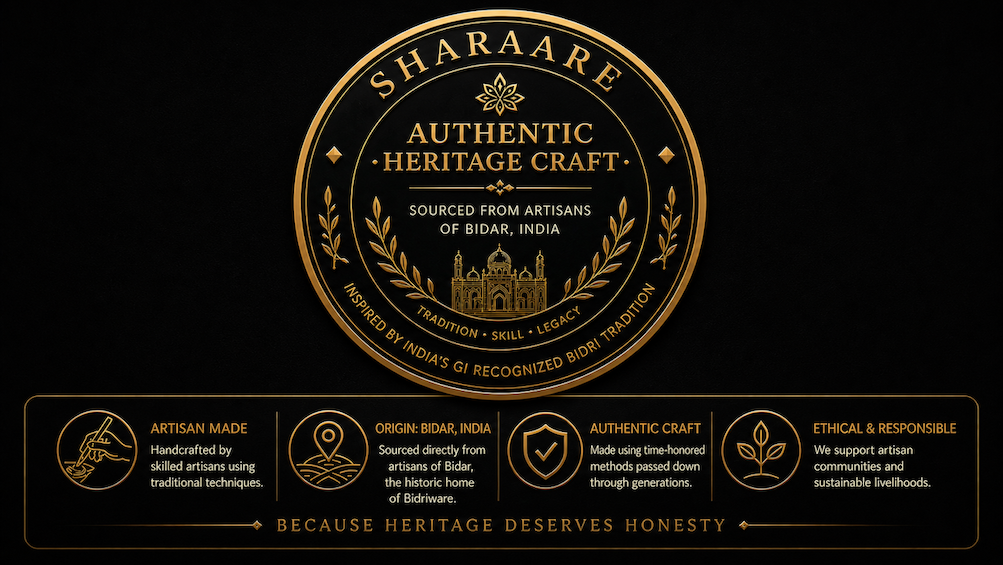
Our Pledge of Authenticity · Because Heritage Deserves Honesty
GI-Tagged · A Protected Heritage Craft of Bidar, India
Caretaking
Bidriware is famously low-maintenance — the blackened body never tarnishes, and the inlaid silver deepens with a graceful patina. A gentle, mindful ritual is all that is needed to keep each piece radiant for generations.
Use a soft, dry cotton or microfiber cloth. Wipe along the inlay, not across, to avoid catching the edges of the silver motifs.
For deeper cleans, rinse briefly in lukewarm water with a drop of mild, neutral soap. Avoid prolonged soaking.
Pat dry immediately with a lint-free cloth and let it air-dry fully in a shaded place before placing back on display.
If the inlay dulls, lightly buff with a silver polishing cloth. The dark body itself needs no polishing — it is permanent.
Correspondence
For commissions, provenance enquiries, or to be invited to a private viewing — leave a message and our atelier will reply within two working days.
Sharaare · Sparks of Heritage